

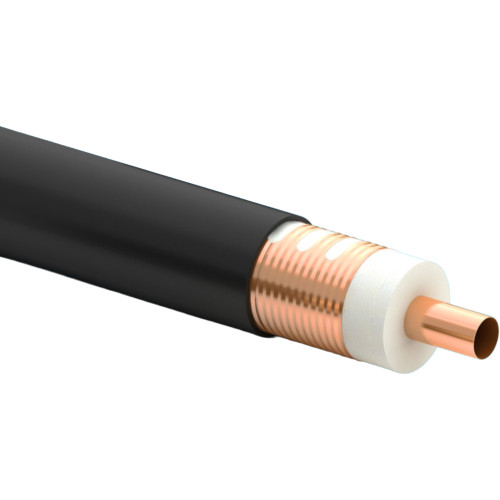
The EUCARAY RMC 78-B "A" Series is a 7/8 inch radiating cable (also called a leaky feeder or radiating coax) engineered by Kabelwerk Eupen AG in Belgium for dependable RF coverage in tunnels, buildings, parking structures, and other confined or hard-to-reach spaces. Operating across 30 to 2400 MHz, it delivers homogeneous, continuous signal distribution for TETRA, GSM-900, and GSM-R networks and supports simultaneous transmission of multiple wireless services on a single run.
Its patented slot design holds coupling loss low across the band, while the 7/8 inch profile balances low longitudinal loss with a tight bending radius for faster, cleaner installs. A halogen-free, low-smoke, flame-retardant jacket makes it well suited to public safety and transit environments where fire behavior is scrutinized.
Key Features and Benefits
- Broadband coverage: 30 to 2400 MHz with resonant frequencies positioned in non-used bands of the spectrum.
- Low coupling loss: patented slot-group design for even, predictable signal distribution.
- Easy to route: 350 mm minimum single-bend radius lets you follow tunnel walls and tight pathways.
- 50 ohm impedance with a smooth copper tube inner conductor and corrugated copper foil outer conductor.
- Fire-safe jacket: halogen-free, low-smoke, flame-retardant polyolefin, CPR compliant to EN 50575.
- Best performance-to-cost ratio in the medium-frequency radiating cable class.
Main Applications
Built for in-building and in-tunnel distributed coverage where a standard antenna cannot deliver an even signal:
- Road, rail, and metro tunnels
- Public safety and TETRA radio coverage
- GSM-900 and GSM-R rail communications
- Underground stations, parking garages, and confined commercial spaces
Technical Specifications
| Size | 7/8" |
| Frequency Range | 30 to 2400 MHz |
| Recommended Frequency Bands | TETRA, GSM-900, GSM-R |
| Cable Type | RMC (Radiated Mode Cable) |
| Slot Design | Groups of slots at short intervals |
| Impedance | 50 +/- 2 ohm |
| Velocity Ratio | 88% |
| Capacitance | 72 pF/m (22 pF/ft) |
| Inner Conductor DC Resistance | 1.63 ohm/1000m (0.5 ohm/1000ft) |
| Outer Conductor DC Resistance | 2.50 ohm/1000m (0.76 ohm/1000ft) |
| Inner Conductor Material | Smooth copper tube |
| Dielectric Material | Cellular polyethylene |
| Outer Conductor Material | Overlapping corrugated copper foil with slot groups |
| Jacket Material | Flame-retardant polyolefin (halogen-free, low-smoke) |
| Diameter, Inner Conductor | 9.2 mm (0.362 in) |
| Diameter, Dielectric | 23.5 mm (0.925 in) |
| Diameter Over Jacket | 27.0 mm (1.063 in) |
| Minimum Bending Radius (Single Bend) | 350 mm (13.78 in) |
| Cable Weight | 0.400 kg/m (0.269 lb/ft) |
| Tensile Strength | 130 daN (287 lbf) |
| Indication of Slot Alignment | Embossed line 180 degrees opposite |
| Storage Temperature | -70 to +85 C (-94 to +185 F) |
| Installation Temperature | -25 to +60 C (-13 to +140 F) |
| Operation Temperature | -40 to +85 C (-40 to +185 F) |
| Recommended Clamp Spacing | 1.0 m (3.28 ft) |
| Distance to Wall (Recommended / Min.) | 80 to 180 mm (3.15 to 7.00 in) / 50 mm (1.96 in) |
Longitudinal Loss and Coupling Loss
Coupling loss measured in tunnel per IEC 61196-4 Ground Level Method at a 2 m distance. C50 and C95 are average coupling losses with 50% and 95% probability, calculated to the standard.
| Frequency | Longitudinal Loss dB/100m (dB/100ft) | Coupling Loss C50% (dB) | Coupling Loss C95% (dB) |
|---|---|---|---|
| 75 MHz | 1.30 (0.40) | 56 | 67 |
| 150 MHz | 1.62 (0.49) | 60 | 65 |
| 225 MHz | 1.91 (0.58) | 62 | 72 |
| 380 MHz | 2.47 (0.75) | 60 | 64 |
| 450 MHz | 2.72 (0.83) | 59 | 63 |
| 790 MHz | 3.84 (1.17) | 54 | 57 |
| 870 MHz | 4.10 (1.25) | 53 | 56 |
| 900 MHz | 4.19 (1.28) | 53 | 56 |
| 960 MHz | 4.38 (1.34) | 52 | 55 |
| 1800 MHz | 6.97 (2.13) | 66 | 78 |
| 2170 MHz | 8.08 (2.46) | 65 | 76 |
| 2400 MHz | 8.77 (2.67) | 64 | 75 |
Nominal values, subject to manufacturing tolerances: longitudinal loss +/-5% and coupling loss +/-5 dB. As with any radiating cable, real-world performance in a building or tunnel may differ from figures measured to IEC 61196-4. Free Space Method coupling loss measurements are available on request.
Certifications and Fire Behaviour
- Halogen-free, low-smoke, flame-retardant outer jacket
- Low corrosive gas emission to IEC 60754-2
- Flame retardant to IEC 60332-1-2 and IEC 60332-3 Cat. C
- Low smoke emission to IEC 61034
- Reaction to fire to EN 60332-1-2, Eca class
- CPR compliant to EN 50575
Recommended Connectors and Tools
Order the matching connectors and preparation tool for a clean, low-VSWR termination:
| 7-16 Female connector | 716FR78A |
| 4.3-10 Female connector | 43FR78A |
| N Female connector | NF50R78A, NM50R78A |
| Cable preparation tool | SPTC50R78 |
Frequently Asked Questions
What is a radiating (leaky feeder) cable used for?
A radiating cable distributes RF signal evenly along its entire length through controlled slots in the outer conductor, instead of radiating from a single antenna point. This makes it the standard solution for continuous coverage in tunnels, underground stations, parking garages, and large buildings where a point-source antenna leaves dead zones.
What frequency bands does the RMC 78-B "A" Series support?
It operates from 30 to 2400 MHz and is recommended for TETRA, GSM-900, and GSM-R. A single run can carry multiple wireless services at once.
Which connectors fit the RMC 78-B "A" Series?
Use the 7-16 Female (716FR78A), 4.3-10 Female (43FR78A), or N Female (NF50R78A / NM50R78A) connectors, prepared with the SPTC50R78 tool.
Can it be installed in tunnels and underground?
Yes. Coupling loss is rated using the IEC 61196-4 tunnel Ground Level Method, and the flame-retardant, halogen-free, low-smoke jacket suits enclosed public safety and transit environments.
What is the impedance and minimum bending radius?
The cable is 50 ohm with a minimum single-bend radius of 350 mm (13.78 in), which keeps installs manageable around tight tunnel and building pathways.
Is the jacket fire-rated?
Yes. It is halogen-free, low-smoke, and flame-retardant, rated Eca for reaction to fire under EN 60332-1-2 and CPR compliant to EN 50575.