

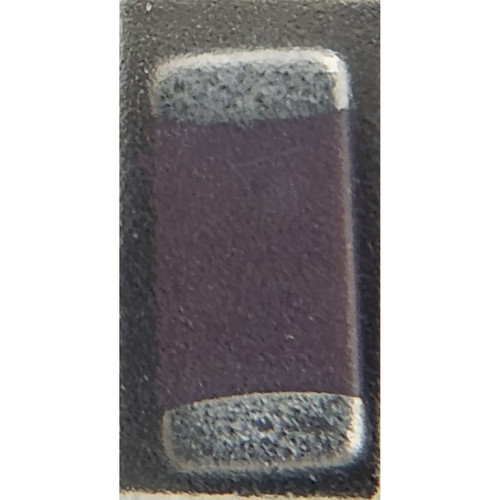
Ultra-Stable Class 1 Ceramic Capacitor for Critical RF Frequency Control
The Motorola 2113740B34 is a precision Class 1 (NPO/C0G) ceramic chip capacitor specifically designed for frequency-critical applications in Motorola two-way radio circuits. This component features 24 picofarad capacitance with an exceptional ±30 ppm/°C temperature coefficient, delivering superior stability compared to standard NPO capacitors. Class 1 dielectrics are the industry standard for circuits where capacitance stability directly affects radio frequency accuracy, channel spacing, and regulatory compliance. The 24pF value is commonly specified in crystal oscillator load networks and VCO tuning circuits where precise frequency control is essential for licensed radio operation.
Key Features
- Genuine Motorola component ensures exact specifications matching original radio design
- 24 picofarad capacitance optimized for crystal oscillator and RF tuning applications
- Class 1 NPO/C0G dielectric provides exceptional temperature stability (±30 ppm/°C maximum)
- Precision-grade tolerance tighter than standard ±100 ppm NPO capacitors
- Ultra-low dissipation factor ensures minimal signal loss in RF applications
- High Q factor exceeding 1000 at 1 MHz maintains sharp circuit resonance
- Surface mount chip design enables compact layouts and automated assembly processes
Technical Specifications
- Motorola Part Number: 2113740B34
- Component Type: Multilayer Ceramic Chip Capacitor (MLCC)
- Capacitance: 24 pF (picofarads)
- Tolerance: Typically ±1 pF or ±5% (whichever is greater) for Class 1 types
- Dielectric Type: Class 1 NPO (C0G) - Temperature-Compensating Ceramic
- Temperature Coefficient: ±30 ppm/°C maximum (precision specification)
- Operating Temperature Range: -55°C to +125°C
- Rated Voltage: Typically 50V to 100V DC for this capacitance range
- Dissipation Factor: <0.1% at 1 MHz (exceptionally low loss)
- Insulation Resistance: >10,000 MΩ minimum
- Q Factor: >1000 at 1 MHz (high quality factor)
- Mounting Style: Surface mount chip capacitor
Compatible Radio Models
This component is used in various Motorola portable and mobile two-way radio models, particularly in precision RF circuits including crystal oscillator load networks, voltage-controlled oscillators (VCOs), phase-locked loop synthesizers, and temperature-compensated frequency references. The tight ±30 ppm/°C specification indicates this capacitor is specified for circuits where frequency stability directly affects FCC compliance and operational reliability. Consult your radio's service manual or contact a Motorola authorized service center for specific compatibility and circuit location information.
What's Included
- One (1) Motorola 2113740B34 Class 1 Ceramic Chip Capacitor
Applications
- Crystal oscillator load capacitance for reference frequency generation in synthesizers
- Voltage-controlled oscillator (VCO) tuning and temperature compensation circuits
- Phase-locked loop (PLL) synthesizer loop filter and frequency control networks
- RF impedance matching networks requiring temperature-stable performance
- Transmitter frequency stabilization and carrier generation circuits
- Receiver local oscillator precision tuning and frequency control
- Temperature-critical timing circuits and frequency references
Installation and Service Notes
Professional installation by qualified radio technicians with surface mount soldering experience and RF alignment capability is required. This precision capacitor requires a temperature-controlled soldering station with fine conical tip (350°C maximum tip temperature), precision tweezers or vacuum pickup tool, fine-diameter solder wire (0.5mm or smaller) or solder paste, no-clean flux specifically formulated for SMD work, and magnification equipment (stereo microscope 10-20x recommended). The work area must be ESD-protected with proper grounding including anti-static mat, grounded wrist strap, and ionizer if working in low-humidity environments, as electrostatic discharge can damage the dielectric and cause performance degradation or latent failures.
Surface mount installation procedure: Clean PCB pads thoroughly with 99% isopropyl alcohol using lint-free wipes and allow complete evaporation. Inspect pads under magnification for oxidation, contamination, or damage. Apply minimal no-clean flux to both pads using a precision applicator or small brush. Orient the capacitor correctly (non-polarized component, either orientation acceptable) and position precisely using vacuum pickup tool or precision tweezers. Tack-solder one end first by simultaneously applying iron tip to pad and feeding minimal solder to create the joint, maintaining contact for no more than 2 seconds to prevent thermal damage. Allow 5 seconds cooling time, then repeat on the opposite end. Inspect both solder joints under magnification for proper concave fillet formation, complete wetting to both pad and component termination, and absence of defects including cold joints, insufficient solder, solder bridges, or flux residue that could introduce parasitic capacitance.
This capacitor is typically replaced during troubleshooting of frequency-related failures including transmitter frequency drift exceeding regulatory tolerance (±2.5 ppm maximum for narrowband Part 90 systems), receiver frequency instability causing adjacent channel interference or reduced selectivity, synthesizer unlock conditions or increased phase noise, failure to maintain frequency accuracy across full operating temperature range (-30°C to +60°C typical), or intermittent frequency errors during thermal cycling. In crystal oscillator circuits, the load capacitance must match the crystal's specified load (typically 18pF, 20pF, or 32pF) to achieve the correct operating frequency. Even 1-2pF deviation can shift the frequency by several parts per million, potentially causing the radio to operate outside its assigned frequency allocation and violate FCC regulations.
After installation, comprehensive RF alignment and frequency verification are mandatory. Use a calibrated frequency counter with ±0.1 ppm accuracy minimum (NIST-traceable calibration required) or communications service monitor to verify transmit and receive frequencies. Perform temperature cycling verification by measuring frequency at minimum three temperature points: -20°C (cold soak), +25°C (room temperature), and +60°C (elevated temperature). Many professional service centers use temperature chambers for this verification. For transmitter circuits, verify output power meets specification (typically ±1 dB tolerance), modulation characteristics are correct (±12.5 kHz deviation for analog FM, verify bit error rate for digital modes), and spurious emissions are suppressed below -70 dBc. For receiver circuits, verify sensitivity meets specification, adjacent channel rejection is adequate, and frequency accuracy is maintained. Document all measurements in the radio's service record including date, technician identification, and test equipment serial numbers and calibration dates.
Never substitute this component with capacitors having wider temperature coefficients, different dielectric types, or non-Motorola part numbers. Standard NPO capacitors with ±100 ppm/°C coefficients will not provide adequate frequency stability. X7R capacitors (±15% capacitance change with temperature) are completely unsuitable and will cause severe frequency drift. Generic capacitors with "similar" specifications may have different parasitic properties including series inductance, equivalent series resistance (ESR), or Q factor that affect RF circuit performance unpredictably. Always use the exact Motorola part number to ensure identical electrical characteristics and temperature performance matching the original circuit design.
This component is intended for service by Motorola authorized service centers, professional radio technicians with proper RF test equipment, and experienced electronics repair specialists. Required test equipment includes: frequency counter or service monitor with ±0.1 ppm accuracy, RF power meter with 0.1 dB accuracy, spectrum analyzer for spurious emission verification, modulation meter with 0.1 kHz accuracy, and ideally environmental chamber for thermal cycling verification. Due to the critical nature of frequency stability in licensed two-way radio systems and stringent FCC Part 90 compliance requirements, end-user installation without proper test equipment and training is strongly discouraged.
Manufacturer Part Number: 2113740B34
Description: Class 1 Ceramic Chip Capacitor, 24pF, NPO/C0G, ±30ppm/°C
Dielectric Type: Class 1 NPO (C0G) Temperature-Compensating
Temperature Coefficient: ±30 ppm/°C (Precision Grade)
Application: Crystal Oscillator Load, VCO Tuning, Frequency Control Circuits


